
Burnout Isn’t a Workload Problem — It’s a Thinking Problem
Leadership burnout is at an all-time high. But according to Dr. Andre Walton, organizational psychologist, innovation expert, and founder of Plan4Change, the root cause isn’t long hours or too much responsibility.
It’s the way leaders are thinking.
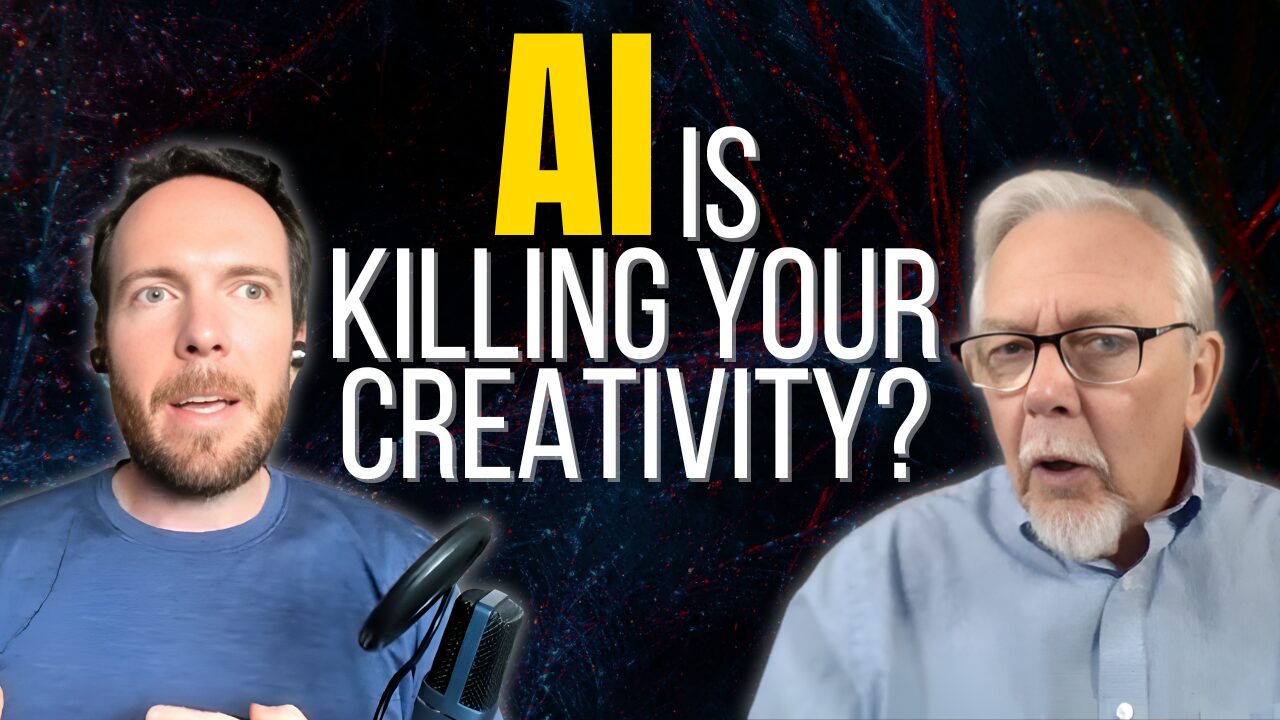
In a recent episode of the Scale Smart Grow Fast podcast, host Harley Green sits down with Dr. Walton to unpack why traditional, analytical problem-solving is draining leaders — and how a different approach, called spherical thinking, helps leaders regain creativity, resilience, and clarity.
Preferred listening on the go? Catch the full podcast episode on Spotify and Apple Podcasts.
Why Smart Leaders Are Burning Out
Most leaders have been trained to rely almost exclusively on analytical, deductive thinking — drilling down, narrowing focus, and optimizing for efficiency. While this approach is useful, Dr. Walton explains that overusing it creates mental “blinders.”
Under pressure, leaders:
- See fewer options
- Feel trapped or reactive
- Lose perspective
- Experience chronic stress and burnout
Burnout, Dr. Walton argues, isn’t simply about workload. It’s about a lack of perceived resources and options. When leaders can’t see alternative paths forward, stress compounds — even if the workload hasn’t changed.
The Two Thinking Systems in the Brain
Neuroscience research using functional MRI (fMRI) shows that creative thinking and analytical thinking activate different neural pathways.
- Analytical thinking is convergent and narrowing
- Creative thinking is divergent and expansive
Modern leaders are heavily conditioned to suppress creativity in favor of logic and efficiency. Over time, this imbalance doesn’t just reduce innovation — it weakens emotional intelligence and resilience.
What Is Spherical Thinking?
Spherical thinking is the ability to balance and switch between creative and analytical thinking depending on the situation.
Dr. Walton compares it to a jazz musician:
- Structure and discipline provide the foundation
- Creativity and improvisation create breakthroughs
Effective leaders know when to analyze — and when to step back, explore options, and think creatively. This balance allows leaders to:
- Make better decisions under pressure
- Adapt to complexity and uncertainty
- Recover faster from setbacks
The Hidden Risk of AI for Leaders
The episode also explores the growing reliance on AI tools in leadership and decision-making.
Emerging research suggests that executives who over-rely on AI may experience declines in critical and creative thinking. When leaders outsource too much cognitive effort, those mental “muscles” weaken.
The solution isn’t avoiding AI — it’s using it intentionally.
Dr. Walton recommends using AI as a thought partner, not a replacement:
- Ask AI to generate ideas, not just answers
- Use it to brainstorm, challenge assumptions, and expand perspective
- Stay actively engaged in the thinking process
Leaders who use AI this way often increase their cognitive capacity rather than diminish it.
Practical Ways to Rebuild Creativity and Resilience
Dr. Walton shares simple, practical ways leaders can re-engage creative thinking daily:
- Break routines with small, intentional changes
- Make novel choices instead of default ones
- Visualize future scenarios creatively, not just logically
- “Shake the snow globe” to disrupt automatic thinking patterns
These small shifts reopen neural pathways connected to creativity, emotional intelligence, and resilience.
The Bottom Line for Leaders
Burnout doesn’t mean you’re failing as a leader.
It means the challenges you’re facing require a different way of thinking.
Leaders who develop spherical thinking don’t just survive pressure — they perform better because of it.
📚 Connect With Dr. Andre Walton
If you want to go deeper into spherical thinking, creativity, and leadership resilience, here are the best ways to connect with Dr. Walton:
- 🌐 Organization: Plan4Change
- 📧 Email:
- 📘 Book: Creative Thinking: A Coach’s Perspective (International Bestseller, available on Amazon)
If burnout is a thinking problem, the solution starts with better support.
Book a discovery call with Workergenix to learn how an Ultimate Executive Assistant can help you reclaim focus, expand your options, and lead with clarity instead of constant pressure.
Like what you read? Get weekly insights on scaling, efficiency, and profitability—straight to your inbox. Click here to subscribe.Transcript:
Harley Green: Hey everybody, welcome back to the Scale Smart Grow Fast podcast. Leaders often get stuck in reactive patterns that drain their teams and themselves. Dr. Andre Walton is going to be sharing a game-changing framework for how leaders can shift from burnout to brilliance using spherical thinking, a proven neural strategy for innovation and resilience. Drawing from his multicultural leadership experience and work with top organizations like Virgin Group and the Smithsonian, Dr. Walton is going to unpack how creativity is not a luxury, but a leadership imperative. Dr. Walton, welcome to the podcast. How are you doing today?
Andre Walton: Thank you very much, Harley. I’m doing great, and it’s nice to see you again.
Harley Green: Well, could you maybe share a little bit more about your background and what brought you to doing what you’re doing today?
Andre Walton: Sure. I’ve always had a very close link to creativity. Both my parents were artists of very high quality. My dad was actually a world-renowned artist. I did a lot of sciences and math at high school and promptly left school to get a job as a graphic artist for a publishing company. Somehow or other, I’ve always been attracted to things related to creativity.
In my twenties, I started inventing and patenting things. Over the next fifteen years, I took two of those inventions to become world leaders in their fields. One strand of my DNA is creativity. Another strand is business. And the third one really is education and coaching.
After my entrepreneurial time of life, I decided to go back to school and get my PhD as a mature student, although my friends wouldn’t necessarily agree with that description. My focus was organizational-level creativity.
Since that time, I’ve been helping organizations—you mentioned a couple of them—Virgin Group and the Smithsonian, as well as NASA, Lloyds Bank, and a few others, to become more innovative and to generate spaces that are more conducive to being innovative.
More recently, I’ve been working on this concept of there being two different ways of thinking. This was kind of a theory in the back of my mind twenty years ago. More recently, with functional MRI technology being available, those theories suddenly came to life.
For anyone not familiar with functional MRI, we all know what an MRI is. If you fall down and hit your head, you might get an MRI to check for damage. Functional MRI is exciting because you can actually look at neural pathways lighting up as people think different thoughts.
Those bath-time theories I came up with in the early 2000s were validated when people discovered that there are physically different neural pathways when you’re thinking creatively versus analytically.
That led me to the idea that we have these two neural pathways. When I studied that further, I realized that in the contemporary world we live in, surrounded by enormous levels of complexity compared to what our brains evolved for, we’ve been socialized into thinking in a very deductive and analytical way.
There’s an imbalance. The side of our brain that relates to creative thinking tends to have been suppressed. If you look at how our world has evolved, it’s far more technological than artistic. That imbalance, I believe, has negative consequences.
One of those negative consequences shows up in the rapid increase in burnout, anxiety, and stress disorders. The prevalence of these conditions has gone up and up over the past few years.
One important factor about creative thinking is that it is inherently divergent. Divergent thinking tests are used by social psychologists to measure creativity as a proxy. By divergent, I mean openness.
Imagine being teleported into a completely unfamiliar country. Your mindset would have to be very open. You’d be seeing strange things. When I first went to India, I was sitting in a little three-wheeler taxi driving in and out between huge elephants. It felt surreal. If you dreamed it, you’d think it was strange, but there it was in real life.
You have to accept that things are strange but functional. When you get into analytical thinking, it’s the opposite. People use phrases like “drill down.” Deductive analytical processes encourage you to focus more and more narrowly.
Under stress, that leads to what I call the hamster-wheel effect. It’s like a racehorse wearing blinders. You see the world through an ever-decreasing window.
The brilliance of using creative thinking with people experiencing burnout is that it removes those blinders. People under severe stress or anxiety don’t see options clearly. Their brain becomes so focused on stress that their available options disappear.
Harley Green: There’s a lot to unpack there. I’ve got a lot of questions, and I’m going to try to combine a couple that are related and something we talked about before we started recording. You mentioned that there have been studies recently showing that people who use AI tools a lot tend to have decreased creativity in their thinking. You also mentioned this idea that when we’re trying to solve problems, we’re trained to drill down and get very analytical, which creates blinders. I’ve seen that when trying to use AI to help with challenges, it can feel like the AI itself gets those blinders too. I wonder if that’s connected, that the way we’re thinking gets translated into how we use AI. Can you address the connection between creativity and AI in modern leadership?
Andre Walton: Absolutely. There was a very interesting piece of research uncovered a few weeks ago and reported in Harvard Business Review. The researchers compared two groups: a group of executives who used AI regularly and a group who did not.
They found that the group using AI tended to have poorer results when it came to measuring critical thinking. That got me thinking about why that might be.
The human brain is intrinsically always looking for ways to be efficient, even lazy. We see this across many areas of psychology. If you imagine you’ve employed the most brilliant person in the world, someone with infinite knowledge who can answer any question, you really have two choices.
You can sit back and let them do all the work, or you can say, this is someone I can learn from. The natural inclination for most people is to let the tool do the work.
AI can alleviate the requirement to think creatively or critically. You see this even in casual use. For example, with career clients who need to generate a resume, they can either sit and actively think about what matters in their life, or they can give all the data to AI and let it generate a polished document.
They often think the result looks amazing and stop thinking about it entirely. The cognitive work has been dramatically reduced.
Critical thinking, which is closely related to creative thinking, is a muscle. If you don’t use it, that neural pathway weakens. This is visible neurologically.
Creative thinking will become the differentiator between people who use AI to increase their cognitive capacity and those whose cognitive capacity decreases as a result of using AI.
Harley Green: Can you share examples of how leaders can use AI to help increase cognitive ability and creativity? We talked about resumes as an example of shutting off thinking, but what are some ways leaders can leverage AI to increase creativity and analytical thinking?
Andre Walton: That’s a great question, and this thought process is still developing. But if you put a prompt into AI asking it to solve a problem, you’ll get one type of output. If you instead ask it to generate ideas related to solving the problem, you get a very different outcome.
One gives you an answer that may or may not be optimal. The other gives you a range of ideas you can engage with, react to, and build upon.
Eventually, you might say, now that we’ve explored these ideas, help me refine a solution. The key point is that you’ve participated in the cognitive route to the outcome.
It’s like the difference between asking for an answer versus running a brainstorming session. In brainstorming, people challenge ideas, discard some, keep others, and work within constraints. There’s interaction.
There’s a strong parallel with how AI should be used.
Harley Green: One thing we’ve implemented with our executive assistants this year is training them to use AI as a thought partner. Before asking it to rewrite something, we have them give it a persona and ask it to interview them to gather context and brainstorm solutions instead of producing an answer. The quality of output and client support has increased dramatically.
Andre Walton: That’s a very enlightened approach, and I’m glad it’s produced great results. AI can hallucinate or get things wrong, and if people become overly reliant, they may not notice those inaccuracies.
It reminds me of autonomous cars. If people get too used to them, they forget how to drive manually. If they suddenly rent a car without automation, they can find themselves making dangerous mistakes.
The same applies to AI. Your process keeps people engaged and aware.
Harley Green: I’ve experienced this with driver-assist technology. Sometimes I forget it’s not enabled and assume the car will slow down for me.
Andre Walton: Exactly.
Harley Green: I want to shift to burnout. You’ve spent years studying it. How do you define burnout, and what misconceptions do leaders have?
Andre Walton: Burnout is often not recognized as a distinct condition. It’s usually lumped under work-related stress. Stress is often defined as an external force crushing your ability to cope.
I define stress differently. I define it as a lack of resources to deal with a challenge.
People often ask why burnout happens now and not six months ago, even when circumstances haven’t changed. The difference is internal resources.
Burnout happens when the internal capacity to cope no longer matches the external demands.
This is important because many people believe a vacation will fix burnout. They return feeling slightly better, but quickly fall back into burnout because the underlying issue wasn’t addressed.
Stress doesn’t switch on and off between work and home. It carries across contexts. Burnout is often about whether someone feels they have options.
If people feel stuck in their job and stuck in their personal life, burnout becomes much more likely.
With burnout clients, I focus on the three Rs: recreation, responsibilities, and relationships. These areas must be addressed in both work and personal life.
Harley Green: You talk a lot about spherical thinking. What is it, and how does it contrast with linear or reactive thinking?
Andre Walton: Spherical thinking is about balancing the two thinking styles and being able to switch between them.
Think about a jazz musician. There’s structure, coordination, and discipline. Then there’s improvisation. Knowing when to move between those modes is critical.
Leaders need analytical thinking to run a business, but they also need creative thinking to solve novel problems. Spherical thinking is the ability to choose the right mode at the right time.
Harley Green: How does spherical thinking help increase resilience in the workplace?
Andre Walton: Spherical thinking leads to higher emotional intelligence. fMRI studies show that the neural pathways associated with creativity overlap with those tied to emotional intelligence.
Resilience fails when people feel they lacked the resources to meet a challenge. When leaders use both structure and creativity, they maximize their chances of success.
Even if things don’t go perfectly, knowing you explored all options strengthens resilience.
Harley Green: What simple, practical changes can leaders make to rewire their brain for creativity and innovation?
Andre Walton: The easiest approach is disrupting routines. Small changes matter. Drink a different beverage in the morning. Choose a different meal. Try a new experience.
Another example is visualizing the future creatively. Create vision boards for trips or projects. This allows you to live in the future and see potential problems early.
Creative visualization both engages creativity and improves planning.
Harley Green: Where can people learn more about you?
Andre Walton: They can email me at .
Harley Green: You recently published a book. Can you share a bit about it?
Andre Walton: Yes. Creative Thinking: A Coach’s Perspective became an international bestseller. It explores creativity from early human history to modern leadership and explains how creative thinking is innate and recoverable.
Harley Green: We’ll link to that in the show notes. If you got value from this episode, hit like, follow, or subscribe. Share it with a leader who needs it. Thanks for tuning in, and we’ll see you next time.