How to Lead in Flow and Scale Without Burnout — Insights from Dr. Kevin Gazzara
If you’re constantly juggling tasks, reacting to fires, and ending your days wondering where your time went—you’re not alone. But what if the problem isn’t how much you’re doing, but what you’re doing?
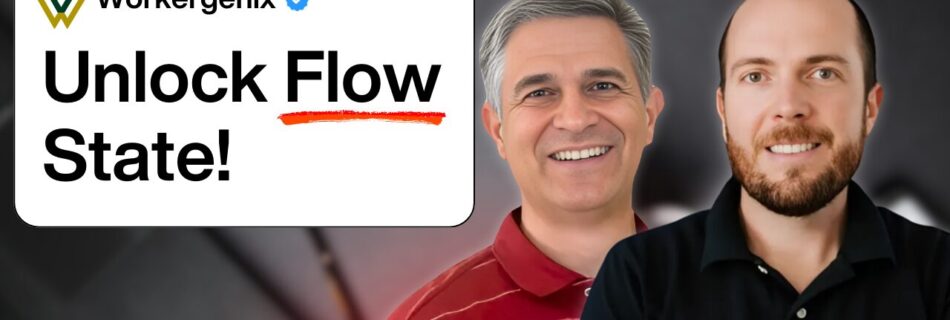
In the latest episode of the Scale Smart, Grow Fast Podcast, we sat down with Dr. Kevin Gazzara, CEO of Magna Leadership Solutions and former Intel exec, to talk about one of the most overlooked levers for leadership success: flow state.
Preferred listening on the go? Catch the full podcast episode on Spotify and Apple Podcasts.
🔄 The 3 Types of Work That Rule Your Day
According to Dr. Gazzara, all tasks fall into one of three categories:
- Routine work (e.g., emails, admin)
- Troubleshooting (fire drills and problem-solving)
- Project work (strategic, long-term goals)
Most leaders are misaligned in how they manage these. Kevin’s research shows that when you discover your personal task cadence—the right mix of these three types—you boost engagement, motivation, and performance.
🧠 The Flow State Formula
Flow happens when your skills meet the right level of challenge. That’s why leaders thrive when they spend time in their optimal cadence of task types. For Kevin, that’s:
- 50% project work
- 30% troubleshooting
- 20% routine
The key? Know your cadence and structure your day around it—not the other way around.
🔄 Delegation Isn’t Dumping
Kevin’s delegation mantra is simple:
If holding onto this task is blocking someone else’s development—delegate it.
True delegation empowers others, while “dumping” just offloads busywork. The goal is mutual growth.
🔁 Rebalancing Beats Restructuring
One standout tactic: the Task Auction. Instead of restructuring teams, Kevin helps orgs plot out their task types, then redistribute them based on individual flow preferences. The result? Up to 80% of “drudge work” can be realigned—boosting motivation and slashing burnout.
🎯 Productivity Tips That Work
- Time block with a buffer (multiply your estimate by 2.5x)
- Use tools like Pomodoro to stay in flow
- Get a “capability partner” to check in regularly—not for pressure, but for clarity and progress
🎁 Want to find your task cadence?
Dr. Gazzara created a free assessment based on his doctoral research:
👉 Take the Task Quotient Assessment
🚀 Ready to lead in flow and scale without the stress?
Let’s explore how we can help you build a smarter, more aligned business.
📅 Schedule your FREE discovery call today — no pressure, just a conversation about where you are and where you want to go.
Like what you read? Get weekly insights on scaling, efficiency, and profitability—straight to your inbox. Click here to subscribe.Transcript
Harley Green
Hey guys, welcome back to the Scale Smart Grow Fast podcast. Today, Dr. Kevin Gazzara is the CEO of Magna Leadership Solutions and a seasoned executive coach known for helping leaders unlock high performance by balancing the right types of work. With over 18 years at Intel and a doctorate in organizational leadership, Kevin brings deep expertise in management, team development, and emotional intelligence. His practical framework for finding flow empowers leaders to delegate wisely, focus strategically, and scale with clarity and impact. Kevin, thank you for coming on the podcast today. How are you doing?
Dr. Kevin Gazzara
Fantastic. Thanks for sharing me with your audience. I appreciate that.
Harley Green
It’s my pleasure. Kevin, can you share a little bit more about your story and what brought you to helping business owners get into FlowNow?
Dr. Kevin Gazzara
Sure, I’d be glad to do that. My background, similar to yours, I think, is from a technical perspective. I did my undergrad work in engineering and business, did an MBA, and ultimately did my doctoral work in organizational leadership and management. I spent 18 years at Intel, fantastic experience, wonderful company, learned so much, great learning culture. But I had a personal goal, and I had a great mentor and coach. At 40, I had this 10-year plan that at 50, I wanted to retire and give back by working with other companies to help grow their leadership. Fortunately, I was able to do that. I had a wonderful financial advisor. Of course, you have to have your finances in order. At 50, myself and two of my colleagues from Intel decided to leave and do what we were doing for Intel for other companies.
My last 10 years at Intel were spent managing Intel’s management leadership development for the world. I managed residential programs at Intel University. I really enjoyed seeing the light go on for executives and managers to get to the next level. We used to train 2,500 managers and leaders in 10 different countries each year for the programs that I had developed and was managing. When I retired 18 years ago, we had just finished training our 40,000th manager. I got pretty good at that, and I wanted to bring that knowledge, expertise, and hopefully passion and enthusiasm to small to medium-sized companies that didn’t have $10 million budgets to spend. I’ve been able to do that with lots of companies around the world, both virtually and in person. In addition to that, I’ve been a professor at six different universities teaching management, leadership strategy, marketing, and business development.
Harley Green
That’s an amazing service you’re offering people now with all that expertise that you’ve developed from your time at Intel and now sharing with people that don’t need to have the massive budgets and staff that Intel might have and still get those great benefits. Now, we talked about flow a little bit in the intro. What led you to develop this concept of leadership flow and why is it so critical for executives and leaders looking to scale?
Dr. Kevin Gazzara
First, let’s talk about the concept of flow. Many people kind of understand what it is, but if you don’t, we’ll do the one-minute version. Flow was developed by a professor named Dr. Mihaly Csikszentmihalyi. He was the Department Chair of Psychology at the University of Chicago and later moved to the Drucker School of Management in Claremont, California. In his work in the late 80s and early 90s, he identified the concept of flow. It’s when your skill meets the right challenge. In the 90s, it was re-termed as being “in the zone.”
The easiest way to tell if you’re in the zone is that the sense of time becomes severely distorted. You’re working on something, and you look up at the clock thinking it’s 9 o’clock, but it’s midnight. That’s an indication that you’re in flow. I was always fascinated by this concept. I believed that if people could get into flow and stay in flow the majority of their time, they would be much more motivated and engaged.
When I worked at Intel and was finishing my doctoral degree, I noticed something interesting. I’d visit my staff members, and each one had a different preference for tasks. One would love task A and hate B and C. Another would love A and C but hate B. Another would love C but hate A and B. These were people with similar backgrounds, styles, and experience. So, I hypothesized that each person has a different preference for task types. If we could identify that preference, we could get people into flow more consistently.
There are three tasks we do regularly: routine tasks (like emails), troubleshooting tasks (problem-solving), and project tasks. Bill Daniels at American Training and Consulting found these are the core types. My theory was that everyone has a different mix that works for them, and if we can match the work to the person’s preferred mix, we can increase motivation, engagement, and the chances of getting into flow.
I wrote to Dr. Csikszentmihalyi and asked if he’d be on my committee for my dissertation and help me develop an assessment based on his concept. He agreed. We developed the Task Quotient (TQ) assessment. Normally we charge for it, but I’ll share a free link later. My research proved that if you can structure your day around your ideal task mix, it significantly boosts motivation and engagement. It doesn’t guarantee flow, but it works incredibly well as a foundation. We now use this framework in our Leading Forward Academy and other leadership programs.
Harley Green
That’s really fascinating. So with these three types of work or tasks, have you found that to get in that flow state, it’s a mixture of time spent or an order of operations? Or is it best if someone just does the one type they’re best at?
Dr. Kevin Gazzara
Great question. What we found is that you need to identify your cadence. For example, my cadence is roughly 50% project work, 30% troubleshooting, and 20% routine work. I encourage anyone who takes the assessment to figure out the cadence of their tasks. Cadence refers to how long you can stay focused on each type of task before needing to switch.
For me, I can do about 30 minutes of routine work, around an hour of troubleshooting, and two hours of project work. If I go beyond that, I get distracted. The key is to switch to a different task type—not just a different task. If you’re doing emails (routine) and switch to another routine task, you’re still in the same task type and not refreshing your brain. That’s why batching similar tasks can feel like drudgery.
Each task type gives different feedback. Routine work has high frequency but low intensity feedback—like deleting emails. Troubleshooting offers medium frequency and intensity. Project work gives low frequency but high intensity satisfaction—finishing a course, delivering a product. People have different preferences based on how much and what type of feedback they need.
Harley Green
That makes perfect sense. Once someone knows their task cadence, how do they stay consistent and avoid distractions?
Dr. Kevin Gazzara
Great question. First, eliminate distractions—turn off email notifications, phones, Alexa announcements, etc. If you’re a high-need executive, use a process: block time on your calendar, and set up auto-replies or voicemail saying, “I’m working on a project; text me if urgent.” This keeps interruptions low while maintaining responsiveness.
Second, get a capability partner—not an accountability partner. Share what you aim to accomplish daily. Most people create long lists, complete two things, and end up demotivated. A partner helps you stay focused and realistic.
Also, use a 2.5x buffer rule. If you think something will take two hours, block five. Often we underestimate time due to unexpected tasks or complexity. If you finish early, use that buffer time. Most people take on more than they can handle because they don’t factor in the time it takes to keep the business running—what we used to call KTBR at Intel.
Harley Green
That time inventory is so important. Often, people realize they’re doing a lot that could be delegated. When does it make sense to bring on executive support like an assistant?
Dr. Kevin Gazzara
Our process starts with tracking tasks for at least a week. Once you map your tasks by type, you can see what causes boredom or anxiety. Then we run a task auction. Everyone lists what they want to offload, and others can volunteer to take it on. It’s not bartering—it’s about matching people to tasks they actually enjoy. We’ve seen organizations reassign up to 82% of work this way.
There’s always leftover admin work—”crap work”—which is the perfect reason to hire a VA or executive assistant. Rather than paying a $120K engineer to handle service calls, you can hire someone for a fraction to handle administrative tasks. We even did a case study that saved a company $50K and increased job satisfaction by 26%, reducing turnover to zero.
Harley Green
That’s powerful. Delegation is essential but often misunderstood. How do you teach leaders to delegate well?
Dr. Kevin Gazzara
We teach a simple rule: if by holding on to a task, you’re hindering someone else’s development, then delegate it. Even if it takes them four hours instead of your one, it builds their skill and confidence. You can mentor and support them through it. That’s leadership development. Dumping is giving away things you don’t want to do. Delegation is about opportunity and growth.
Harley Green
I love that. My wife and I often ask, “How do we never have to do this again?” It makes the investment in training someone else worth it. One last thing—can you talk more about how some leaders feel guilty offloading tasks they dislike?
Dr. Kevin Gazzara
People assume that if they don’t like a task, no one else will either. But we all have different strengths, experiences, and preferences. What drains you could energize someone else. That’s why having conversations around task rebalancing—not just delegating—is so important.
Harley Green
Awesome. Kevin, you’ve shared so much value today. Where can people take the Task Quotient assessment and learn more?
Dr. Kevin Gazzara
We set up a special link: magnaleader.co/GIFT. It takes less than five minutes and gives you a personalized report on your task balance. If anyone wants a short summary of the dissertation that validates this framework, email me at . I also welcome conversations—no sales pitch, just happy to help. You can connect with me on LinkedIn as well.
Harley Green
Thank you again, Kevin. To our listeners—if you found value in this, hit like and subscribe so you never miss future strategies to help you scale smarter. And share it with someone who could use this right now. See you in the next one!