
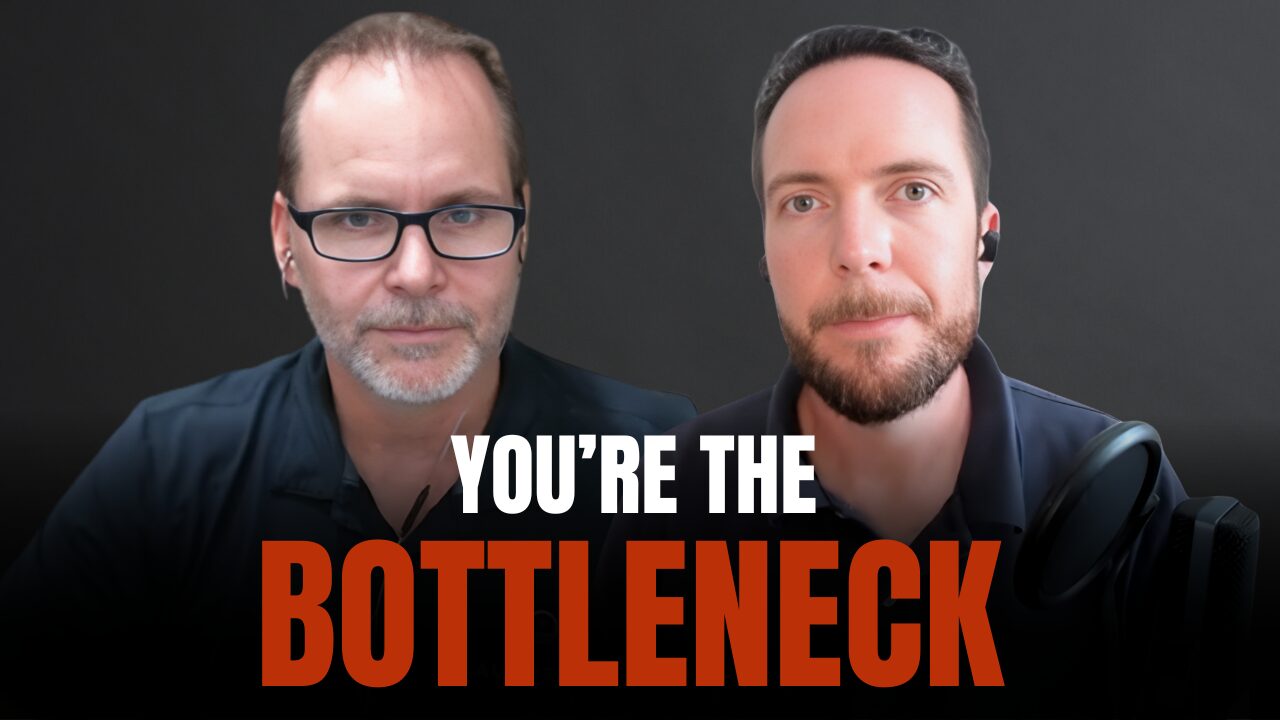
Why You’re Still Stuck in the Day-to-Day (And How to Break Free)
If you’re a founder or business leader still caught in the weeds—managing calendars, answering emails, and putting out fires—you’re not alone. But staying stuck in the day-to-day is not the cost of building a successful company.
In a recent episode of Scale Smart, Grow Fast, host Harley Green sat down with Ken Wimberly, founder of Laundry Luv and a serial entrepreneur with over two decades of experience. Ken has mastered the art of scaling with systems, service, and soul—without burning out.
Preferred listening on the go? Catch the full podcast episode on Spotify and Apple Podcasts.
Here’s what you’ll learn from his journey—and how you can apply it today.
🚧 The Trap: Doing Everything Yourself
Ken’s early entrepreneurial days were all hustle, no structure. Like many founders, he thought doing it all was the only way to succeed.
The breakthrough came when he realized: you can’t scale if you’re the bottleneck.
🧰 The Tools That Changed Everything
To escape the grind, Ken implemented the Entrepreneurial Operating System (EOS)—a game-changing framework that helped him align his team, define roles, and lead with clarity.
He also built a powerhouse team of virtual executive assistants. One VA has been with him for over 12 years, helping run four different companies.
“If you don’t have an assistant, you are the assistant.” – Ken Wimberly
💡 Daily Huddles = Daily Clarity
Ken starts each day with a 15-minute huddle to align priorities and check in personally with his team. These meetings, inspired by Dan Martell’s Buy Back Your Time, are followed by focused 1-on-1s.
Short. Consistent. Game-changing.
🕒 Calendar Blocking = Time Ownership
Ken “weaponizes” his calendar using color-coded time blocks for deep work, family, strategy, and more. His VAs overlay this framework to protect his focus and maximize every hour.
📈 KPIs That Reflect Purpose
At Laundry Luv, impact is more than a buzzword—it’s a business metric. His team tracks:
- 📚 Books given to kids
- ❤️ Lives positively touched
- 🛠️ Community engagement initiatives
Because when your business is built to serve, the profits follow naturally.
🔄 Want to Scale Without Burnout?
If you’re tired of being the bottleneck:
- Build systems like EOS
- Hire before you’re “ready”
- Empower your team with clarity
- Track what really matters
- Start small—with a daily huddle
📬 Connect with Ken Wimberly
🔗 Learn more about Laundry Luv: https://www.laundryluv.com/
🔗 Connect with Ken and access free tools: https://www.kenwimberly.com/
Ready to stop drowning in daily tasks and start leading with focus?
💼 Book a discovery call with Workergenix and find your Ultimate Executive Assistant today.
Like what you read? Get weekly insights on scaling, efficiency, and profitability—straight to your inbox. Click here to subscribe.Transcript
Harley Green:
Hey everybody. Welcome back to Scale Smart, Grow Fast. Today we’re going to talk about what if scaling a business didn’t mean burning out or compromising your values? Today’s guest, Ken Wimberly, is proof that growth doesn’t have to come at the cost of your soul. He’s the founder of Laundry Luv, a modern community-centered laundromat brand, and a serial entrepreneur who spent 20 years building scalable businesses rooted in legacy, leadership, and purpose. In this episode, you’ll learn how to systemize for freedom, lead with clarity, and grow a business that makes you proud. Ken, welcome to the podcast. Maybe you can tell us a little bit more about your background as an entrepreneur.
Ken Wimberly:
Hey Harley, thanks for having me. I’ve been looking forward to this. Entrepreneurially, it’s almost all I’ve ever done. I spent a short stint in the Navy in the middle of college. When I graduated, I had my first and only two jobs. One was in the insurance and investment business. From there, I launched a pizza startup. It wasn’t a full franchise, more like a quasi-licensed brand. It failed, oddly, because of real estate issues, which is ironic since I spent the next 20 years in real estate.
After that failure, I worked briefly for about a year as a GM at a restaurant. Then it was into the rest of my entrepreneurial career, which for decades was in the commercial real estate business. I started as a broker in land brokerage, then moved into investment sales. Through that, I got affiliated with the Keller Williams Network, ended up becoming a Keller Williams franchise owner, and started buying real estate. That led to buying a shopping center. We were looking for tenants and realized it would be ideal for a laundromat. We tried to find a laundromat operator and couldn’t, so my partners and I decided to become the operator ourselves. That was the beginning of Laundry Luv.
We wanted to do something different. Laundromats were often gross, dingy, unstaffed, not places for families. We wanted to be the opposite. We aimed to be the family-friendly laundromat—the Chick-fil-A of laundromats. So we created dedicated children’s play spaces in every location. We bring in books, promote childhood literacy, read to kids, and give away books. We do something for our communities every single month. It’s been a blessing—a way to make an impact, have purpose, and build a thriving business.
Harley Green:
That’s an amazing story. I love how it sounds like you learned from some of the challenges or failures that you faced early on, pivoted, took that knowledge, and then made it your special skill or unique advantage. I’d love to hear, what are some of the turning points you experienced with your approach to scaling business?
Ken Wimberly:
One of the most important is the team. Having the right people in the right seats doing the right things is imperative. We’ve got both a physical and virtual team. Virtually, we have team members from around the world. Physically, I’m in Fort Worth, Texas. My partner’s in Austin. We have team members and stores in multiple cities. COVID helped everyone embrace remote work and how to build remote teams. That’s been a game changer.
The other big thing is implementing EOS—the Entrepreneurial Operating System. Not just dabbling, but full-on implementation. We hired an EOS implementer who comes in quarterly. We use all the tools properly. It has streamlined our business, helped define the right seats, identify the right people, and assess whether they want the job, can do the job. It’s been a huge win.
Harley Green:
I love that you brought that up because one of the questions I was going to ask was what systems you use for your hybrid teams. You’ve got people all over the world and you answered it with EOS. That’s something we’ve also implemented. I also love how when we were coordinating this podcast, you immediately brought in one of your executive assistants. I’d love it if you could share your thoughts on leveraging executive assistants for founders and business leaders. A lot of people think it’s easier to do it themselves or don’t want to give up access to their inbox. What are your thoughts?
Ken Wimberly:
The first hire we need to make is the executive assistant. If you don’t have an assistant, you are the assistant. Managing your inbox alone is hours of time. My calendar too. That’s been harder for me to give away, but now during my morning huddle with my EA, I just say, “Davidson, add this, change this, move this meeting.” It saves so much time.
He coordinates everything. Instead of emailing back and forth to change a meeting, Davidson handles it. That alone saves hours. But there’s more—Davidson is a master at graphic design. That’s his core skill set. He handles my presentations, branding materials, and more. Right now, he’s building a brand book for Laundry Luv. He’s so good. Sure, I could do it, but it would take forever and wouldn’t be nearly as good. My time is better spent on deep thinking and vision for the company.
He also manages my social media. I was telling him yesterday—it’s like listening to my own voice when he posts. He watches my podcasts, listens to my language, and uses AI tools for clips. He’s become that good. Then there’s Melissa, my first VA hire 12 years ago. She’s now my wife’s primary EA. She’s been with us through four companies. Melissa and Davidson are like family to me. Every morning, we do a huddle: me, my wife, and our two VAs. We each share something we’re grateful for, then the three main priorities for the day, and if we need help. Then we go into our 1:1s—me with Davidson, my wife with Melissa.
We use Dan Martell’s “Buy Back Your Time” format. The 30-minute morning structure gets us aligned and moving fast. It’s been crucial. I can’t say enough about the importance of bringing on a VA or EA.
Harley Green:
I love that you brought up morning huddles and check-ins. Many people struggle with VAs because they don’t do regular check-ins. They treat them like a black box. I’m curious—what strategies or mindset shifts helped you build trust with your team and allow them to take ownership?
Ken Wimberly:
It’s an evolution. Like with any hire, they come in not knowing anything. They need to be trained. When I first hired Melissa, I wasn’t great at training her. But once I had an in-house admin take over her training, it got way better. When Davidson came on, Melissa trained him. Every team member needs proper training and oversight. The daily huddles are critical. I didn’t use to do them, but I’ve learned to implement them. I also R&D a lot—rip off and duplicate. If I see a model working, I adopt it.
My partner Skyler had another great system—Friday one-on-ones with each team member. It’s a check-in: how are they doing personally, with family, health, etc. If something’s wrong, that’s all we focus on—how to help. If things are good, we move on to weekly goals, what got done, communication, and support needs. It’s not robotic—I know the questions, and we have a natural conversation. Sometimes I lead, sometimes my wife. It builds a deeper relationship beyond just business.
Harley Green:
I’m glad you brought up checking in with employees on a personal level because so many times that side isn’t talked about. There’s often no natural opportunity to bring it up in traditional business meetings, and that can lead to negative performance, burnout, or turnover. As business owners, there are often simple solutions—time off, a small adjustment, support—that can make a huge difference. We’ve seen major improvement in our business by doing the same thing.
Speaking of balance and helping people, you’ve got a lot going on. In addition to Laundry Luv, you’re still active as a commercial real estate investor. How do you balance your time between your different endeavors?
Ken Wimberly:
The first thing I do is weaponize my calendar. Everything goes on it. If someone looked at my calendar, it might overwhelm them, but for me it creates clarity. I know exactly what I’m supposed to be doing at any given time. Most of my time is spent on Laundry Luv. We’re growing, franchising, building stores, and supporting franchisees, so it requires a lot of focus.
I still do real estate investments with partners, but I don’t do brokerage anymore. I do maintain referral relationships because people still see me as the real estate guy. Again, it all goes on the calendar. It’s color-coded—Laundry Luv, real estate, personal, family. Date nights with my wife are on there. My kids’ sports events are on there. Everything is intentional.
Davidson helps manage my calendar. He knows what’s coming in and how to prioritize it. I also mapped out what I call my ideal calendar. I took this from Dan Martell. I mapped out everything—from my early morning personal routine, workouts, family time, deep work blocks, and flex time.
Davidson has this overlay of my ideal calendar, so he knows not to schedule meetings during deep work time. That alone took a few hours to build, but once it was done, everything started flowing better.
Harley Green:
I love that. We do something similar with time blocking. How often do you revisit that ideal calendar? Do your priorities shift enough that you need to adjust it, or does it give you enough flexibility?
Ken Wimberly:
There’s enough flexibility built in. The reality of my calendar doesn’t always match the ideal perfectly. Some days require full-day commitments, travel, or discovery days. But the ideal calendar serves as a guide. When I’m traveling or in all-day meetings, that takes priority. Having a framework helps me return to balance faster.
Harley Green:
You mentioned EOS earlier, so I’m sure you’re big on KPIs. What are some of your favorite metrics that tell you when systems are working—or when something’s off?
Ken Wimberly:
EOS has been incredible for that. As a team, we defined the KPIs that truly matter. We revisit them annually to make sure they’re still relevant. For my role, it’s about pipeline—how many people are active and how many are moving toward meaningful engagement.
Because we’re community-focused, we also track impact. We track how many books each store gives away to children every week. We track how many lives we’ve positively touched. That wasn’t always on the scorecard, but we realized if it’s important, we should measure it. Our store managers report these numbers weekly, and it’s powerful.
Harley Green:
I’d love for you to share one of those stories—how you’ve impacted lives in the community and what effect that’s had on the business.
Ken Wimberly:
One example is our Thanksgiving dinner giveaway. We give $50 grocery gift cards so families can have a Thanksgiving meal. We hear stories every year from people who say they wouldn’t have had Thanksgiving dinner without it.
Every August, we do back-to-school backpack giveaways. With our vendors’ support, we provide hundreds of backpacks filled with supplies. Families line up outside the store. Kids are excited, parents are relieved. It’s incredibly meaningful.
Another story that always moves me involves Clay, our first store manager and now Director of Facilities. We call him the Minister of Love. One day, he noticed a customer who was visibly upset. The man was being evicted and his truck was broken down. Clay didn’t hesitate. He spent hours helping him move his belongings so they wouldn’t be lost. Clay is in his 60s, moving furniture without question. Stories like that happen every week. Sometimes it’s just showing up, seeing people, and doing something small that makes a big difference.
Harley Green:
That’s incredibly inspiring. For those listening who might be interested in Laundry Luv, what makes an ideal franchisee or operator?
Ken Wimberly:
We look for people who want to work with a team and appreciate structure and systems. You don’t have to do it alone, but you do need to be aligned with leadership and service. Some business or leadership experience helps—marketing, accounting, operations. Veterans are a great fit for us. My partner and I are veterans, and we support them heavily.
This is a profitable business, but profit isn’t our first driver. We believe in doing good by doing good. The more good we do, the more good comes back.
Harley Green:
We feel the same way. As we wrap up, what’s one shift business leaders can make this week to free up their time and feel more in control?
Ken Wimberly:
Get comfortable with delegation. Ask your team to bring three potential solutions when they bring you a problem. That teaches them to think critically and solve problems on their own. Over time, you stop being the bottleneck, and the business starts running smoothly.
Harley Green:
Ken, where can listeners connect with you and learn more about Laundry Luv?
Ken Wimberly:
You can visit LaundryLuv.com—L-U-V—to learn about the business and franchise opportunities. For more about me, go to KenWimberly.com. I share a lot of free resources there—systems, documents, and tools that help streamline business and life.
Harley Green:
To our listeners, if you got value today, hit follow and subscribe, leave a rating, and share this episode with someone who needs it. Thanks for tuning in to Scale Smart, Grow Fast. Until next time, keep scaling smart.