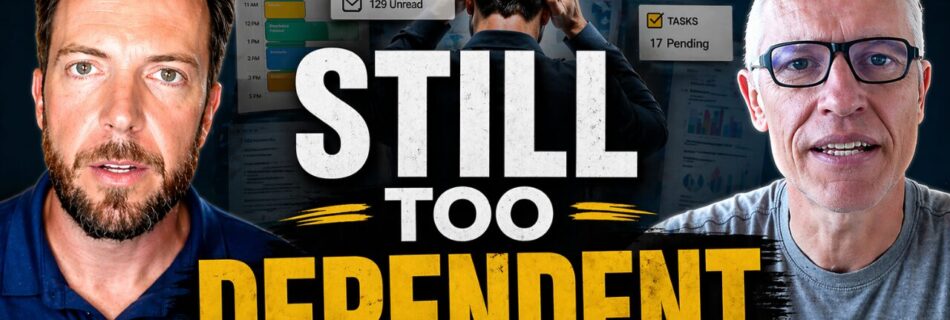
At a certain stage, growth stops feeling like progress and starts feeling like pressure. Revenue is up. The team is larger. Opportunities are expanding. But execution still routes through the same place. The founder. The operator. The decision-maker.
Inbox volume increases. Follow-ups stack. Deals move slower than they should. And despite adding people, the system still depends on one node to keep everything moving.
This is where most operator-led businesses stall. Not from lack of opportunity. From constrained leadership bandwidth.
The Hidden Constraint
The constraint is not time. It is not talent. It is not even capital.
The constraint is being the execution hub.
When every decision, clarification, or follow-up loops back to the founder, the system cannot scale. It becomes reactive by design. Even strong teams underperform because they operate without true ownership. The leader remains the point of coordination, correction, and completion.
This creates three predictable issues:
• Decision fatigue from constant low-leverage inputs
• Execution drag from delayed handoffs and approvals
• Cognitive overload from tracking everything mentally
At that point, adding more people or tools does not solve the problem. It amplifies it. More inputs. More coordination. More noise.
The Operating Shift
The shift is not “delegation” in the traditional sense. It is ownership transfer through structured execution systems.
Delegation fails for experienced operators when it is treated as task assignment rather than system design. Simply handing off work without defining how it gets done, how it is tracked, and how quality is measured creates more friction than relief.
The principle is straightforward:
Leverage is created when execution continues without the leader’s direct involvement.
That requires three components:
- Clearly defined workflows
- Decision-making frameworks that remove ambiguity
- Consistent follow-through that does not depend on reminders
Without those, the leader remains the fallback for everything.
Execution in Practice
There are several practical shifts embedded in this conversation that map directly to scaling discipline and operational leverage.
1. Breaking Work Into Discrete, Trainable Units
Most operators underestimate how much of their workload is undefined. Tasks live in their head. Decisions are made contextually. Processes are implied, not documented.
The correction is to break work into discrete, repeatable actions.
Instead of “manage deals,” it becomes:
• Update deal sheets
• Track follow-ups in CRM
• Coordinate communication with partners
• Maintain timeline checkpoints
This reduces cognitive load and enables clean handoffs. It also creates a foundation for execution systems that can scale.
2. Eliminating Re-Decisions Through Structure
One of the largest hidden drains on leadership bandwidth is re-deciding the same things repeatedly.
When processes are unclear, teams escalate decisions unnecessarily. When expectations are not documented, leaders re-explain standards. When workflows are inconsistent, execution varies.
Structured systems eliminate this.
Checklists. SOPs. Defined communication loops.
Not as bureaucracy. As a way to remove variability and preserve decision-making capacity for higher-value work.
This is where decision-making frameworks become critical. They allow teams to operate within boundaries instead of waiting for instructions.
3. Separating Value Creation From Task Execution
Early in a career, value is tied to output. Time at the desk equals productivity.
At scale, that model breaks.
The highest-leverage activities are no longer task-based. They are strategic:
• Capital allocation
• Relationship development
• Opportunity identification
• High-level decision-making
When leaders stay embedded in execution, they trade these high-value activities for low-leverage tasks.
This is not a time issue. It is a value misalignment.
Operational leverage comes from shifting focus to activities that expand capacity, not consume it.
4. Maintaining Execution Through Consistent Oversight, Not Constant Involvement
A common failure point in delegation is the assumption that once something is handed off, it is “done.”
Execution systems require ongoing visibility.
Not micromanagement. Structured check-ins. Measurable outputs. Clear expectations.
The principle is simple:
What gets measured gets maintained.
Reducing involvement does not mean removing oversight. It means replacing reactive intervention with proactive structure.
This is particularly relevant for distributed teams and remote support. Without clear communication systems, performance drifts. Not from lack of capability, but from lack of alignment.
Leverage Outcome
When these shifts are implemented, the result is not just time savings. It is expanded capacity.
Leaders regain control over:
• Decision pace
• Execution consistency
• Strategic focus
Follow-ups happen without prompting. Projects move without constant supervision. Communication becomes structured instead of reactive.
This creates a different operating environment.
Instead of managing tasks, the leader manages outcomes.
Instead of reacting to inputs, they direct priorities.
Instead of being the bottleneck, they become the multiplier.
This is the difference between growth that feels heavy and growth that compounds.
Connect With the Guest
To learn more about Jens Nielsen and their work:
Website:https://jensnielsen.us/
LinkedIn: https://www.linkedin.com/in/jenswnielsen/
The Immediate Move
Leadership bandwidth is the limiting factor in scaling. Not effort. Not hours.
Without structure, more work simply increases pressure. With structure, execution continues without constant intervention.
The immediate move is to identify where ownership has not been fully transferred.
Where are decisions still routing back to you?
Where are follow-ups dependent on your memory?
Where is execution inconsistent without your involvement?
Replace effort with systems. Replace oversight with clarity. Replace involvement with ownership.
This is how you reduce cognitive load, increase decision speed, and scale without becoming the constraint.
Watch this before you hire your next support role.
Like what you read? Get weekly insights on scaling, efficiency, and profitability—straight to your inbox. Click here to subscribe.Full Podcast Transcript
All right, have you ever hit that point where the money’s working, the career looks solid, but your time still isn’t yours? That’s the tension we’re digging into today on the Scale Smart Grow Fast podcast, because real leverage isn’t just financial, it’s control. And inside Workergenics, we see it constantly. Leaders stuck as the execution bottleneck until an ultimate executive assistant steps in and brings real consistency to how things actually get done. Today’s guest, Jens, made that shift himself.
from decades in IT to building a multi-state real estate portfolio, and now helping other operators level up how they think and perform. Let’s get into it. Yans, welcome to the podcast. Give our audience today a little background about yourself and what brought you to what you’re doing today.
Yeah, thanks, Harley. appreciate it. I, well, first of all, I came to the United States 30 years ago as a young man looking for adventure and started out on the East coast in Maryland, did the typical, you know, got my education, went to college and undergrad and graduate degree in computer science, and then worked, you know, a long career in different companies from
startups to large corporations, to local governments, to Native American tribes, slowly moved west. 20 years ago, we moved to New Mexico. So I’ve lived in New Mexico and Colorado for the last 20 years. Still in IT, stayed in telecommunication IT my whole career. It was great. But in my mid-forties, I realized that something needed to change. I didn’t want to spend the next 20 years working for somebody else.
And then that led to an interest in investing in real estate. So we started investing in apartments like 10 years ago, smaller deals in New Mexico. And then that scaled up to a multi-state portfolio of properties from four units to 200 plus units and so on and warehousing and everything else.
I still do that, but then about five years ago, six years ago when I quit my W2 job, I also started coaching and mentoring because that was really a passion of mine to help the next generation of entrepreneurs.
Awesome, well, I appreciate you sharing that background. I’m sure there were a lot of lessons learned along the way. Hopefully we can dig into some of those. one question I had to start out with is that you probably hit a point where things were maybe looking successful on paper, but the time still didn’t feel like it was yours. Was there a specific moment in your journey where you realized doing everything yourself wasn’t sustainable anymore?
Yeah. You know, I know you traveled too, right? And one of reasons why I wanted to kind of start the real estate investing was to try to decouple my time from my income and so on. Right. So started traveling, but then I’m still sitting on, you know, calls with, with partners and clients. I was like, man, what am I doing? I’m in Spain here to try to ride my bike, but I’m still on calls trying to run the business and so on. that’s
That didn’t really sit that well for me, with me because you hey, yeah, I don’t mind working, but also when I’m off, I need to have the freedom to not work so hard.
What kind of actions did you take to start freeing yourself up and making it so you could really enjoy your time in the moment when you were doing things like bicycling in Spain?
Yeah. Yeah. First, the first was like, so when we were structuring these, when we were structuring real estate deals initially, were like, you know, we can manage them and manage, but I’m not saying property manage, but we can like asset manage them, you know, remotely. That’s just pretty straightforward, blah, blah, blah. It turned out to be very, very hard actually. It was not really, it’s not easy to actually manage these properties remotely and so on. So the first thing was to start hiring actually.
asset managers, know, people that were hired to do that, that work. So we weren’t, you know, trying to make decisions thousands of miles away about, know, should we, you know, very specific details stuff around that. So that was one, one aspect to start getting out of it. Right. And then the other thing was, you know, I used to see from the W2 world, I used to see my, my value as sitting at the desk doing work, right. That’s how you get paid.
So I had a really hard time separating the fact that, if I’m not at my desk, nothing gets done, right? That was the mindset I had. And that really had to shift because first of all, right, if you buy real estate, well, you shouldn’t have to be in there every single day doing the work because then you’re doing something wrong. And then really starting building the right systems and processes so that the people on the ground, the property managers, the asset managers could…
do most of it without having our direct day-to-day involvement with it. So I think that was really the starting point where I started to shift out of this, hey, time for money to mindset.
Yeah, I appreciate that mindset discussion. think a lot of people across the spectrum of industries and businesses, when they go from like solopreneur or employee to like solopreneur and then start having team members, they can have some guilt or maybe subconscious guilt about, you know, having people work while they’re enjoying life. What kind of mindset shifts like or practices or thoughts helps you kind of get over that and realize that it’s okay, you’re, you know, you’re helping these people and life can go on.
Yeah, it has to do with, you know, the value you adding, right? Is your value just your time and there’s no leverage? That’s low value, low skills, low pay kind of work, right? My value is leveling up and bigger strategic, you know, finding investors for our next deal, know, managing or, you know, raising money and finding the next deal and big relationships and so on. And, you know,
I couldn’t do that 20 30 years ago, cause I was just starting out of my career. Now I can. And separating the fact that, the people that are early on in their career, they may have to do that hard work that I did 20, 30 years ago to kind of level up. So I think it’s just realizing where is your biggest value. And for me, it’s absolutely going out there and working on relationships and so on. Right. And it may seem, I mean, it may seem,
Easy, I don’t know if that’s the right word, but it may seem like I’m not working in the same sense, right? But you know, creating relationships and maintaining them, that’s a lot of, that takes effort and time and being in the right rooms as well.
sure. Now as you’re working with other operators today and you see the growth that’s happening in their organizations, what areas in their businesses and operations do you see costing them a lot of focus and time, maybe even trust within their teams?
I think most, most businesses or small businesses, they go from, you know, the solo entrepreneur, somebody has an idea, they start a business and then they start hiring. They never learn how to replace themselves. Right. They just become, as you started out with the bottleneck because they never learn how to actually delegate and leveling up their team and training and so on. Right. So the, I work with anybody, it’s always like, okay, what are you doing? What is the low value?
low pay things that you’re doing that absolutely 100 % should be, you know, hired out for immediately. And you just step out of the way, right? You create a process, a system. I I have have a client who owns a small bakery here. She was in there baking cookies and cakes every day. was like, okay, this is, this is not going to work. Right. So she, she knows you made, it’s like, okay. Because she was so, she was so afraid that the product was not going to be at the qualities she wanted. So after we, you know, okay.
Write out the recipe, train your people on it, and then just do quality control and see if they do a good job. And if they don’t, you correct. So Ziu was able to get out of that, right? And then, you know, it’s just like, I don’t even show up in the shop anymore because I’m like the hood ornament here, right? So that’s kind of the level you want to get to. just get, get out of your own way, right? I think that’s the biggest challenge, but also where you leverage really, you can start leveraging yourself and your team much more.
If someone is kind of in that messy middle and they are trying to just like get out of the way, what are some like mental blocks that you often see people have in getting out of the way and how do you help them overcome those?
Well, the biggest mental block people have is that nobody can do it as well as I can. Right. Nobody is so as good as I am. I totally had that too, when I was moved into management in the IT because like, you know, they can’t do it as well. So that’s the biggest mental block. And I always tell people that, okay, think back, you know, when you started in this career and this business, you probably weren’t very good at it, but somebody was helped you to grow, helped you to.
rise up or you took the training or whatever that is. So put yourself in that earlier version of yourself and have that same patience that somebody had with you with your employee now. And say, okay, it’s okay if they make some mistakes. It’s okay if things are a little bit slower. This is just the nature of human evolution. We got to learn it. We got to grow. We got to go through it.
And, know, be a mentor, be a, be a coach, be a supporter of your team versus that critic versus that, you can’t do it well enough. Let me just do it myself type, type attitude, right? That’s really what I think is so important.
I love that you brought that up because I see this a lot with virtual staffing agency. People come in and oftentimes they have this expectation that an executive assistant is somehow going to just like replace them. And it’s not like that with any employee. In fact, most entrepreneurs cannot just replace themselves. What you kind of alluded to here is you find like specific roles and, you know, break out the pieces that you’re doing and then you hire for those. What are some like methods or,
I guess systems that you kind of coach people on to help identify where they can break out responsibilities and start hiring and start getting out of the way in those areas rather than just like replacing themselves all at once.
Yeah. No, and I’ve had that same challenge there, hiring your VAs and it’s like, well, they should figure it out. It’s all, it’s easy, right? Well, obviously it isn’t. So what I tend to do, you know, it starts with, if I’m working with an owner that needs to start hiring and growing their team, it’s always, let’s just start with the beginning. What are the tasks you’re doing all week? Right? Let’s say you are the baker owner. How much time are you?
Spending on baking cookies and cakes and staffing the front and everything else running to the store. Let’s just break it down and figure out what are all the different tasks that you’re doing. And what are the, and then start with what are the easiest ones. So what are the ones that are easy to train that you hate doing, right? Let’s get those off your plate first. Now, of course that’s a physical thing. It’s a little hard to do remotely, but let’s say, you know, you’re more of a knowledge worker or have a business that that’s not a physical location, right? Just get those.
Simple things that are discrete, repeatable, you don’t like doing, right? So that could be, you know, your social media stuff. could be, you know, customer outreach or prospect outreach, all these different things, but be very specific about what it is and make it discrete and also easy to train. So you can say, okay, here’s how you do it, right? And then you check on it. And I really struggle with that too.
in my W-2 career, because I was like, well, you know, I have smart employees, why can’t they figure it out? Well, because they were much younger in their career and they hadn’t had that growth themselves. So I just had to have patience, train them and so on. Right. I think this morning I’m meeting with my assistant for, for an hour. She’s fairly new. So we’re to really, you know, work on training her up in some of those key things. And in the past, I didn’t have that and I just got irritated and would fire them again. Right. So that’s a learning lesson for me.
Now, one thing that we implement with our clients is providing them with a 30, 60, 90 onboarding plan. So based on the consult call and then discussions that we have with the client about the responsibilities we’re handing off, we’ll help them with making that plan. So they have a clear path to success of like, here’s what you’re handing off in the first 30, then the next 30, and the next 30. And we found that tremendously changes the mindset and the success rate because both sides of the equation, you know, the employee and the
the leader know what’s expected and it’s not this just mass, like here’s everything at once, figure it out, like you mentioned. So I really appreciate you pointing that out. The next question I wanted to ask you was more of like the results. So when you’re working with people and they start handing things off, they’ve delegated, they’ve gotten themselves out of the bottleneck, you know, in addition to just like having the time that they used to be doing free, what are some of the other results you see, whether it’s like, you know, mindset shifts or, you know, what are they doing with that time and how is it impacting their
their happiness and also their business success.
Yeah, I think it’s important as you start handing over what’s the, why are you doing that? Right. You know, because there are people that are solo entrepreneurs that are totally happy doing that. So if you start handing stuff over, is it because you want more time? So you can, you know, do other, other activities or it’s because you want to grow your business. Right. Be very clear on that. The reason why, why, and for most people it’s because they want to grow their business. Right. They want to have.
a business that can function without them and they can truly grow. Um, you know, so I always think about that and say, okay, so if you don’t have to do all these tasks, you don’t want to do, what are you going to focus on? Is it, know, creating new relationships, raising money, new product lines, whatever, or I said, Hey, I just want to work, you know, a few hours a week and the rest of the time, I just want to do my hobbies and so on. That’s totally fine, but be clear on what it is. So you don’t.
Because if people start getting bored, they will just start feeling that David mean, you know, meaningless stuff and they’re just haven’t really won anything. Now they have an assistant to do stuff and they just trying to keep themselves busy by doing things that doesn’t make any sense. Right. So when I’m coaching people, I’m always, okay, you know, what is that? What is the idea life that you’re trying to create here? And let’s make sure that the stuff you can pull the stuff away from you that doesn’t serve you. And you can focus on what’s really going to push you forward.
Absolutely. And when you’re working with people or you’re kind of observing other businesses, what are a few signals that you look for to know that things are working and the leader is actually getting their time back? Sorry, I’m going to… My alarm just went off. Start that question over again. So, when you’re looking with working with people and you’re observing their businesses, what are some signals that you look for to know things are working and the leader is actually getting their time and clarity back?
When I see growth, right? If the goal is growth and I start seeing there is new growth, you know, they’re adding new product lines, they are, or they’re expanding their revenue and so on, right? That’s a pretty obvious thing to measure. But also I would also listen for more subtle clues. Like, you know, I, I was able to, yeah, here’s an example, right? So I work with some real estate agents and stuff and when they can start like not working every single weekend,
they can go on trips with their spouses or they can do other things. I start seeing those shifts, right? Because all the things that they said, I want to try, I want to, know, just go on trips. So I want to go to the gym. want to whatever. When I start seeing that that’s happening, I know that, that it’s working. there’s two, there’s they get their personal, they get their personal time back and they can do someone things. And at the same time, if they can start growing their business, which tends to happen, right? We think that.
We just work harder, things will grow, but we just tend not burning us, burning ourselves out. If we step back, we create space, we get some time to get away and so on. Then the energy is there to take things to the next level.
Yeah, absolutely. Now, kind of as we go to the next level and teams are growing, business is going well, they have that growth. What breaks down around ownership or communication that still catches leaders off guard and how do you help them fix it quickly?
Especially when you have, you know, if you have, executive assistants or VAs that are remote, they still, you know, they can’t read your mind, right? They can’t, they can’t see what’s going on. And if you fail, if you start, if you if you stop communicating well with them, you may run into performance starts dropping or you forget to pay attention to it. Right. And, and you’ll start seeing that where, you know, the the quality drops or.
you know, tasks doesn’t get completed. that’s because typically because the owner becomes complacent, like, I thought I had this solved, but you know, it’s an ongoing kind of involvement with, with your team and so on. Right. So if you just, if you think it’s set it and forget it, then you’re probably going to run into problems down the road. Right. You know, you gotta, you gotta stay on top of it. And it’s the old saying, you know, what, what, what gets measured, get done or whatever, something to that effect. Right. So stay on top of it.
And you know, maybe you don’t have to check in every day, but you can reduce your, your check-in frequency, but it has to still be, has to happen regularly anyway.
Yeah. Now, both of our backgrounds in technology, I have background in computer engineering, your background is computer science and IT. So I think, you know, technology is a big discussion right now across the board in businesses. You know, I’m curious what your take is or philosophy when it comes to, you know, deciding and helping coach business owners on what needs to be automated and leveraging technology versus, you know, what’s delegated and still have a human in the loop.
Yeah, it’s, fun. mean, I’m, I’m just having so much fun playing with Claude and Claude cowork and all these different things. Right. And there is it’s like, wow, it can do that. So there’s definitely a, there’s definitely some opportunity it is. And now the question is, do you have the, do you have the skills to actually truly implement the technology in your business? and can leverage that, right?
Or is it like, well, that’s, I can do it, but it’s going to take a lot of time. And then I have to manage the technology versus managing the people. Right. So it’s a little bit, it’s a little bit of an energy. It’s very full, put your energy on your focus, right? Because a human, you know, it’s easy to say, okay, this need to tweak a little bit or go do something else. You just tell the person, if you’ve designed all these fancy workflows, if they suddenly don’t support you anymore, you got to redesign them all. Right. So I’m.
I’m doing personally, I’m doing a mix. and to be honest, I mean, there’s certain things that I was like, wow, I don’t need my VA to do these things anymore. Cause now Claude can do it for me and so on. Right. So it’s, it’s, but then hopefully I can level her up to do other things that are at a higher level or maybe have her be the person that manages the technology and so on. Right. So I think you definitely as
As a small business owner, mean, there is some technology there you can use. only problem is, do you have the energy and the time to implement it yourself or do you need to go out there and hire agencies to do it? And suddenly the cost probably becomes pretty high and so on. So that’s a balance you have to really think about there.
Yeah. And we’ve observed in our businesses, like we really heavily leverage chat GPT early on, and we’re now being very disappointed by it. And we’re actually shifting focus to using Claude more for a lot of things. And a worry I personally have is, well, what’s the next thing? Are we going to invest all this time and effort getting switched over to Claude and its ecosystem? And then it kind of goes the way of chat GPT and something new comes. And that’s just, guess, the nature of the beast with technology, right?
Yeah, no it is. I mean, just, just out of, mean, you know, I was like the other day, I wanted to go back and look at all my clients and see, okay, who haven’t I spoken to or email for a while. And I said, go through my, go through my, my CRM for former clients, you know, figure out what the last we talked about draft an email for me and so on. Right.
That would have taken me hours to go through that and it would just process through and say, you know, Joe, you talked about blah, blah, blah. And it’s been a year. It’s like, okay, let’s email Joe and stuff like that. mean, things like that, which would be really time consuming for a human to do. It’s like, wow, this is amazing. Right. So there’s so many really cool things to do it, but you know, you know, I’m doing the same thing. I’m going from chat, GPT to cloud, because I feel like it has some functionalities that I like better, but you know, it could be replaced in two months. Who knows? Right.
Exactly. Well, Jens, it’s been an awesome conversation. If someone listening wants a quick win today, what’s one action they can take this afternoon that actually creates momentum for them in their business?
I would make a phone call or a text to somebody that can help grow your business to the next level.
Powerful. Get that leverage. And Jens, if someone wants to connect with you and go deeper on the topics we’ve discussed today, where should they start?
Just at my personal website, so it’s my first name J E N S and last name Nielsen N I E L S E N dot U S Jens Nielsen dot U S. There’s a, phone number on my email is on there. My link to book a call is on there. So that’s the best place to start.
Awesome. And to our audience, I think what really stands out from this conversation is the shift that Yen’s made going from chasing stability to actually designing a life with more control, more intention and real impact. And you can hear how that plays out, not just in investing, but in how leaders think and operate day to day. And because at the end of the day, most people don’t struggle with knowing what to do. It’s the follow through, it’s the execution. And that’s where things quietly break down. And that’s exactly where having the right support matters.
At Workergenics, our full-time ultimate executive assistants step in behind the scenes to keep things moving so you’re not the one holding everything together. If that’s something you’re feeling right now, you can check out workergenics.com and appreciate everyone listening today. We’ll see you all on the next one.